

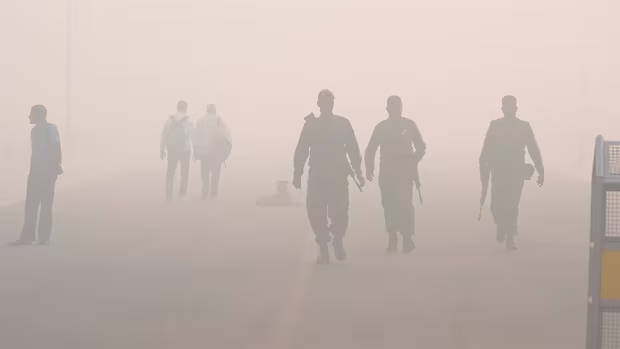
Severe Smog Engulfs New Delhi Following Diwali Celebrations
New Delhi woke up to a dense layer of smog on Monday morning, a direct consequence of firecracker usage during the Diwali festivities. The annual Hindu festival of lights exacerbated the city’s already critical air quality situation, further intensifying the seasonal pollution crisis that plagues the area.
Fireworks Despite Restrictions
Despite government-imposed restrictions on fireworks, many residents chose to mark the Diwali celebration with firecrackers, releasing significant amounts of smoke and fine particulate matter into the atmosphere. The Air Quality Index (AQI) soared above 350 in multiple locations across the capital, indicating a severe environmental health hazard.
Monitoring Stations Report Alarming AQI Levels
Air quality monitoring stations recorded distressingly high pollution levels, with visibility significantly reduced as a dense gray haze enveloped the urban landscape. The grim conditions prompted public concern regarding health implications.
Regulatory Measures and Their Impact
Earlier this October, India’s Supreme Court had mandated restrictions on traditional firecrackers, allowing only approved “green firecrackers” to be used within specified time frames. While these alternative firecrackers are designed to produce fewer emissions, they still contribute to particulate matter and other pollutants in the atmosphere, thereby failing to eliminate the pollution crisis.
Isyad, a resident of New Delhi, expressed his distress over the deteriorating air quality, stating, “Because of the pollution, there is irritation in the throat and itching in the eyes.”
A Seasonal Pollution Crisis
The New Delhi metropolitan area, home to over 30 million residents, often ranks among the most polluted cities globally, particularly during the winter months. Pollution levels worsen considerably during Diwali due to the confluence of firework emissions and smoke from agricultural burning in the adjacent states of Punjab and Haryana.
After harvesting rice, farmers frequently burn leftover stalks to prepare their fields for subsequent planting. This smoke exacerbates pollution from local sources, including vehicles, construction activities, and industrial emissions.
Challenges in Combating Pollution
The situation becomes particularly dire in late October and November, as cooler temperatures and low wind speeds trap pollutants close to the ground, leading to prolonged periods of hazardous air quality.
In response to the dire situation, authorities have enacted various measures aimed at reducing pollution, such as restricting construction activities and diesel generator usage. However, these interventions have not been sufficient in preventing the recurrent spikes in pollution levels.
Call for Long-term Solutions
Environmental advocates stress the necessity for sustainable, long-term strategies, such as the adoption of cleaner energy sources and stricter regulations on vehicle emissions, to mitigate future pollution crises. Shweta Narayan, a public health expert at the Global Climate and Health Alliance, criticized the government’s reactive approach, describing it as “knee-jerk” and “temporary.”
“Many actions are taken only when the government is under pressure to respond,” she noted.

Chief Editor of Quincy City Beat — Quincy, MA's independent investigative newspaper covering Greater Boston and the entire Commonwealth of Massachusetts with fearless public accountability and free access for all readers.










Discussion about this post