

Understanding App Store Rejections: The Security vs. Submission Dilemma
A security scan and an app store review ask different questions. Here’s why app store rejection happens to secure builds, and what enterprise mobile teams check before they submit.
Your build has successfully cleared the binary static application security testing (SAST) and dynamic application security testing (DAST) performed on actual devices. Quality Assurance has provided approval, and the launch date is communicated to customers. However, you receive a rejection from the app store console.
Upon reviewing the security report, you find no issues; it merely highlights that your build is not susceptible to exploitation. The discrepancy arises because the security scan only examines vulnerabilities, while the submission process by Apple and Google evaluates compliance with their specified submission guidelines.
This discrepancy leads to a significant number of rejections. In 2024, Apple rejected approximately 1,931,400 of the 7,771,599 app submissions it reviewed, equating to roughly one out of every four submissions, as referenced in its App Store Transparency Report.
The crux of the issue lies in the differing criteria: security checks focus on exploitability, while app store reviews assess adherence to guidelines regarding privacy, permissions, declarations, billing, and performance standards.
To prevent unexpected delays caused by rejection notices, conducting an app store readiness check on the build prior to submission is essential.
Frequency of Rejections by Apple and Google
Rejections are commonplace enough to warrant strategic planning.
According to 2024 data, Apple scrutinized 7,771,599 applications, ultimately denying 1,931,400 submissions primarily due to performance-related issues, detailed in its App Store Transparency Report.
| Apple Guideline Category | Submissions Rejected in 2024 |
| Performance | 1,235,471 |
| Legal | 445,696 |
| Design | 378,300 |
| Business | 209,845 |
| Safety | 116,105 |
| Other | 23,659 |
Note that a single submission may be rejected for multiple guidelines, causing the totals to exceed 1,931,400.
Meanwhile, Google has reported preventing over 1.75 million submissions that violated its policies in 2025, alongside restricting over 255,000 apps from gaining unauthorized access to sensitive user data, complicating direct comparisons between the two datasets.
The Release-Readiness Gap
Responsibility for vulnerabilities rests with AppSec, functionality is overseen by QA, engineering manages the build process, and the submission task is handled by the release team. As such, the store requirements are often only reviewed for the first time during the app store submission process.
This situation does not arise from a lack of attention to store rules; rather, the existing processes before submission typically lack the checks needed to ensure compliance.
Do Store Console Checks Fill the Gap?
Partially. Google’s pre-review checks can highlight issues like missing mandatory declarations and elevated crash rates, but these issues are only flagged once a release is in the Play Console. Notably, Google emphasizes that “passing all pre-review checks does not guarantee passing the formal app review process.”
Why Does the Gap Widen with a Growing App Portfolio?
Each additional app, release, or regional variant introduces new potential for store issues to arise at later stages. Teams managing numerous apps or frequent releases tied to partners or regulations often face an exacerbated gap.
Elements of App Store Readiness
App store readiness involves ensuring that a build satisfies the published submission rules of the intended store before it is reviewed. It includes checking that declarations align with the actual functionalities of the binary and its SDKs, that permissions are justified by features, billing complies with the store’s policies, and that the release configuration is clean.
This means that the readiness check is focused on the actual build to be shipped, not just its code. Reviewers often scrutinize the following areas:
| Area | Review Criteria | Common Failure Reasons |
| Performance and Stability | Functionality as described, free from crashes or incomplete features | Crashes on specific devices or OS versions |
| Privacy and Data Declarations | Alignment of declared data collection with actual app behavior | Undeclared data collection by third-party SDKs |
| Permissions | Relevance of sensitive permissions to specific features | Permissions requested without valid justification |
| Billing | Adherence to store billing rules for digital goods | Digital goods sold outside the mandated billing system |
| Release Configuration and Declarations | Completeness of required declarations and settings | Missing mandatory declarations during submission |
| Third-Party Components | Compliance of bundled SDKs and services with store policies | A compliant SDK from previous quarters violates a current rule |
Therefore, achieving store readiness is not a one-off process. Both store policies and the internal SDKs within your build are subject to change.
The Impact of an App Store Rejection
An app rejection seldom results in a single fix; rather, it often triggers a cyclical process:
- Analyze the rejection notice and trace the issue back to the build.
- Implement necessary changes, rebuild, and conduct retesting.
- Resubmit and await the review process anew.
- Repeat this for each regional variant, especially if aligned with a predetermined launch date.
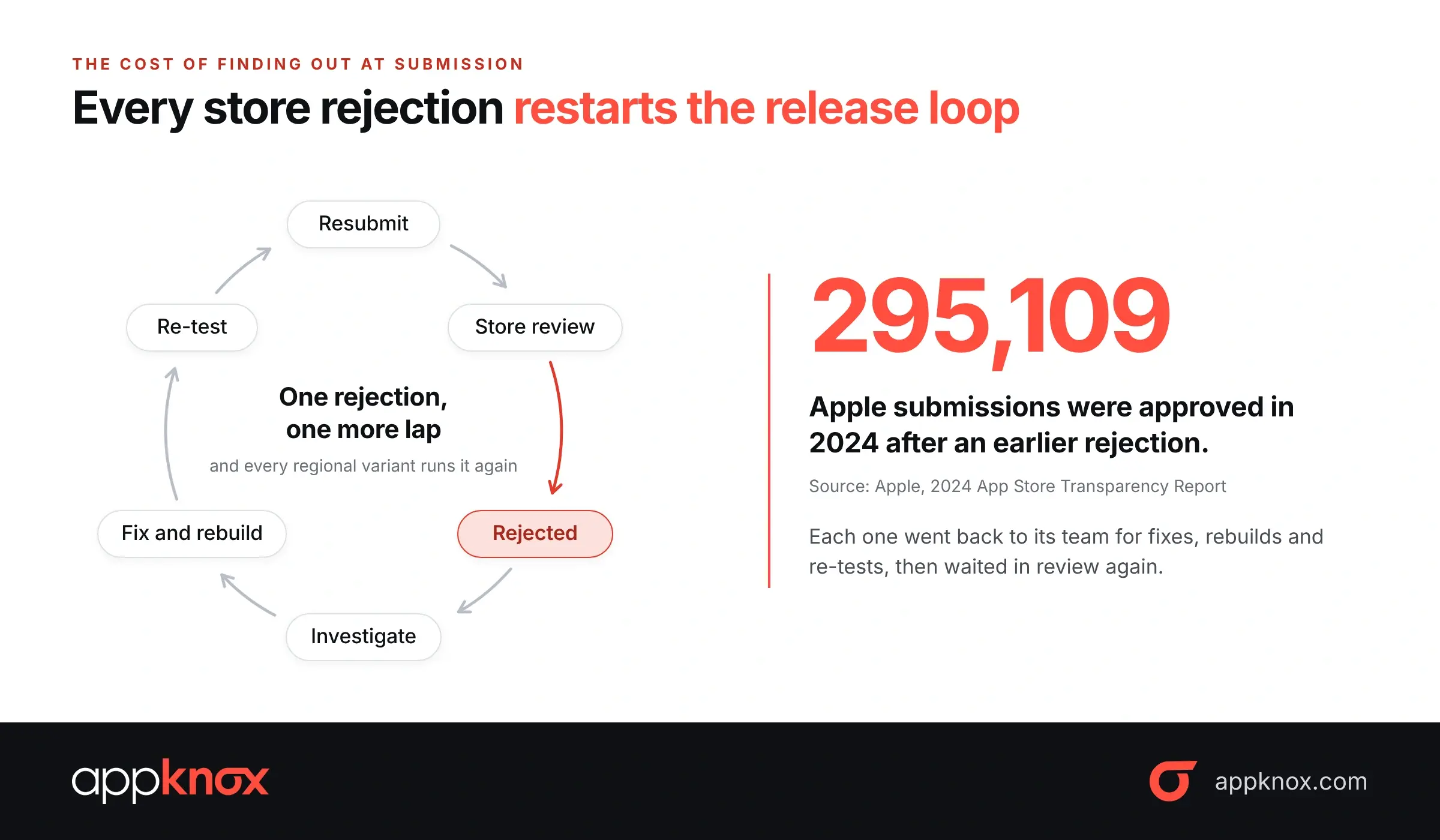
According to Apple’s data, this cyclical nature is evident on a larger scale. In 2024, around 295,109 submissions were approved after an initial rejection, as reported in the Transparency Report.
This indicates that each build underwent further fixes and retesting before awaiting its second review. Notably, security scans do not account for these additional factors.
Checklist for Enterprise Mobile Teams Prior to App Store Submission
For enterprise teams dedicated to delivering mission-critical applications, achieving store readiness is viewed as a structured gatekeeping process, not merely a last-minute review prior to submission. The decisions made regarding app store approval run parallel to security evaluations before the actual submission takes place.
To optimize effectiveness, a few essential practices should be adhered to:
- Ensure alignment between privacy declarations and real data collection. Validate that what the build and its SDKs actually collect corresponds with the store listing.
- Justify every permission request. Each permission should have a corresponding feature that necessitates it.
- Reassess third-party SDKs after any alterations in store policies. A change in policy may turn a previously compliant SDK into a rejection factor.
- Verify that billing procedures adhere to the store’s regulations. This applies to in-app purchases and subscriptions alike.
- Conduct tests on the release build rather than the debug version. Confirm that links to the privacy policy and user account deletion processes are functioning correctly within the binary being submitted.
- Designate one individual to oversee store verdicts. This would mirror the accountability structure for security assessments.
This structured approach is especially critical where timing of launches carries significant financial implications, for example, in sectors like banking where multiple retail and commercial applications must launch simultaneously, or in the travel industry where timely updates are essential for booking processes.
Achieving Store Release Readiness
Appknox offers a Store Release Readiness feature that evaluates each build against the submission requirements of both the Apple App Store and Google Play. It assigns a Release Rejection Risk rating—High, Medium, or Low—and identifies potential blockers along with necessary actions supported by policy references.
If you are already an Appknox customer, this feature is included automatically at no additional charge. New users can initiate a free Store Readiness Scan for their Android builds today.
| Appknox Customers | Free Store Readiness Scan | |
| Access Method | Upload a build in your Appknox dashboard | Upload an APK or AAB on the scan page |
| Cost | Included at no additional cost | Free |
| Store Coverage | Apple App Store and Google Play | Google Play |
| Deployment | Cloud and on-premises | Web upload |
| What You Receive | Rating of Release Rejection Risk, identified blockers, warnings, evidence, policy references, and remediation guidance | An immediate verdict, a Store Readiness Snapshot via email, and an optional 15-minute consultation with an Appknox expert. |
|
No credit card or commitment required. Simply upload your APK or AAB, and the scan will handle the rest—no source code necessary. [Scan your Android build] If you are already an Appknox client, the Store Release Readiness feature will automatically run on your next build upload. |
Frequently Asked Questions
Is it possible for an app to clear a security scan and still be rejected by the App Store?
Yes, it’s possible. Security scans assess exploitability, while app store reviews evaluate compliance with the respective guidelines regarding privacy, permissions, and performance. A build may pass one but fail the other.
What commonly leads to app rejections by Apple?
The leading cause is related to performance. According to the 2024 App Store Transparency Report, Apple rejected approximately 1,235,471 submissions based on performance criteria.
Do pre-review checks by Google Play guarantee approval?
No, Google states that while passing pre-review checks is a positive step, it does not ensure approval in the formal app review process.
Can third-party SDKs lead to app store rejections?
Yes, if a third-party SDK collects data that is not declared in the app’s privacy policy or violates current store policies, that can result in a rejection.
When should teams verify app store readiness?
Before the actual submission, on the same build intended for release. Conducting this check alongside security results allows time for any necessary fixes before the critical release date approaches.

Chief Editor of Quincy City Beat — Quincy, MA's independent investigative newspaper covering Greater Boston and the entire Commonwealth of Massachusetts with fearless public accountability and free access for all readers.










Discussion about this post