

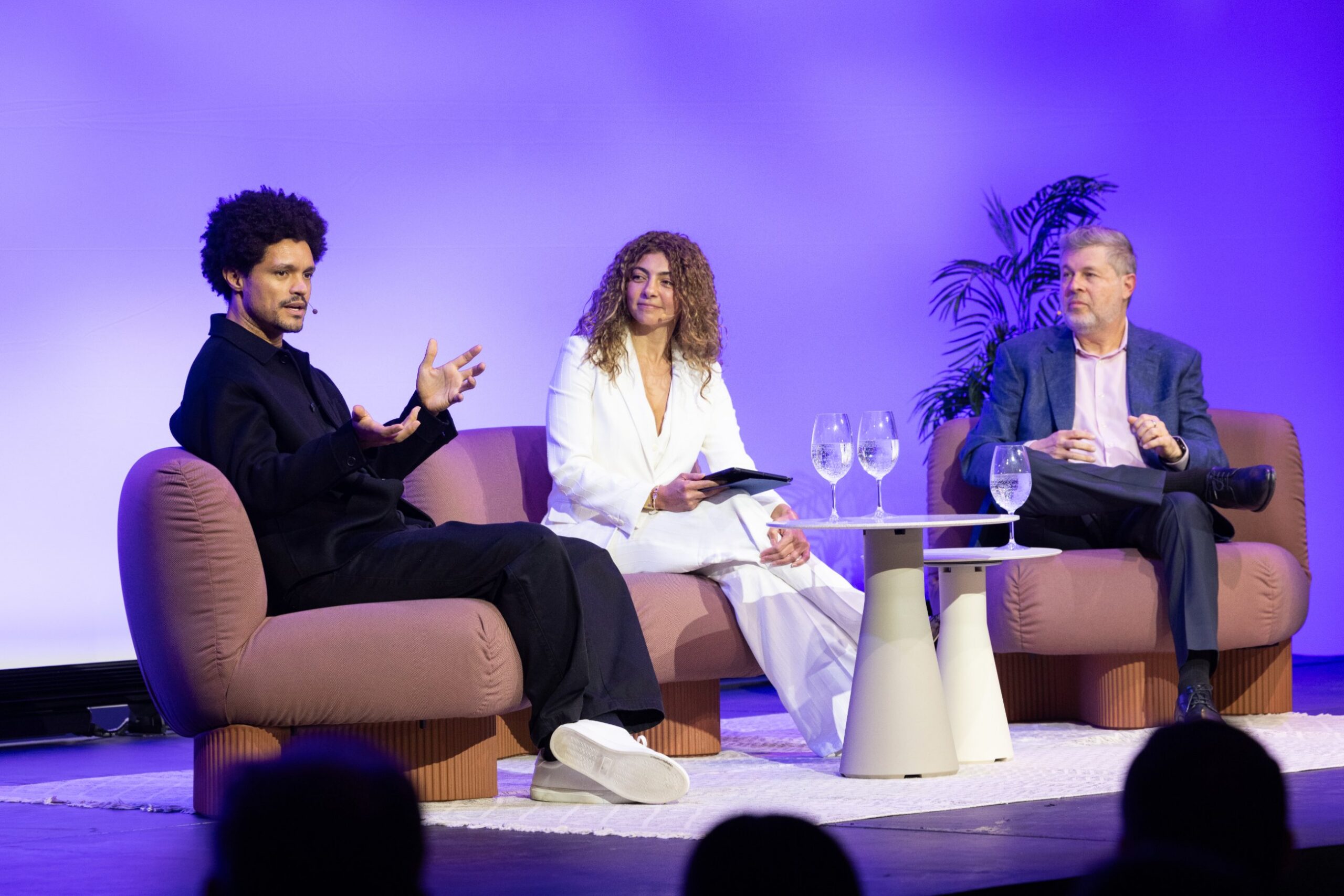
Trevor Noah Launches Science Conversation Series at Boston’s Museum of Science
On October 19, Trevor Noah unveiled Luminaries, a new science dialogue series at the Museum of Science in Boston. Accompanying him on stage was Rana el Kaliouby, a leading voice in emotion AI and host of the Pioneers of AI podcast. Following the event, Rana remarked on Trevor’s unexpected depth and insight, contrasting it with the humor he is widely known for.
Artificial Intelligence: Surface-Level Insights
During the event, Rana shared her experience of using an AI matchmaking program that matched her with Trevor. He noted that the AI lacked true understanding, generating responses based solely on internet searches.
“AI is particularly good at seeming like it has gone beneath the surface, when in fact it’s calculating everything above the surface,” Trevor stated.
He added that while AI can acknowledge mistakes, it seldom makes real corrections, likening this to a friend who has undergone therapy but has not fundamentally changed.
Community as a Countermeasure to Dystopian AI
When asked how to mitigate the negative impacts of AI, Trevor emphasized the importance of genuine human interaction and community. Referencing Robert Putnam’s book Bowling Alone, he highlighted how communities can yield significant societal benefits, including greater governmental accountability.
In response to a critique about the failure of communitarianism, Trevor suggested that overly intellectualized names can hinder movements. He argued against extinguishing ideas simply because of an unsuccessful branding.
“I don’t need to see if you’re a deepfake, because I’m sitting here with you,” he asserted.
Pessimism and Optimism in Technology
Despite concerns regarding AI, Trevor expressed a fundamentally optimistic view of technology. He remarked that historically, advancements such as cars and computers have become widely accessible.
Drawing comparisons to commodities that were once highly valued, he noted how humanity continuously adjusts its valuation of what it produces.
“If we are the people who draw pictures of ourselves on a cave wall, and we sing songs for no reason really, then we’re infinitely capable as creatures,” Trevor added.
The Employment Landscape Amidst AI
Discussing the job market, Trevor drew on his personal experiences while touring as a comedian, observing abandoned communities as industries like Kodak and Studebaker left. He noted that white-collar workers are now experiencing the same disruptions that have long affected blue-collar jobs.
While he remains confident that new job opportunities will emerge as they have in the past, he expressed concern over the transitional period, likening it to maintaining a safe following distance on the highway.
“There is no job that will last forever. The question is, how long is the following distance between the two things?” he remarked.
The Future of Humor in AI
On the topic of AI threatening creative professions, Noah shared his skepticism about AI’s ability to replicate humor. He outlined four key reasons for AI’s shortcomings in comedy, including the lack of diverse comedic data and the model’s inability to adapt to changing social norms.
“I’m trying to understand where the edges are in society, and I want to play with those edges,” he stated.
Trevor Noah: Job Security in a Changing Landscape
In addition to his prominent career as a comedian and author, Trevor Noah serves as Microsoft’s Chief Questions Officer. While acknowledging the role of AI in replacing certain jobs, he humorously noted how he had voiced an AI character in Black Panther: Wakanda Forever.
“Yeah, I’m coming for AI’s job,” he quipped.

Chief Editor of Quincy City Beat — Quincy, MA's independent investigative newspaper covering Greater Boston and the entire Commonwealth of Massachusetts with fearless public accountability and free access for all readers.










Discussion about this post