


Super El Niño Expected to Peak in Late 2026, Leading to Record Global Temperatures
The intensifying phenomenon known as “super El Niño” is projected to reach its peak towards the end of 2026, driving average global temperatures to unprecedented levels as early as next year. This insight comes from Carbon Brief’s latest “state of the climate” update, which utilizes forecasts from various climate models along with comprehensive global temperature datasets.
Dr. Zeke Hausfather, an expert in climate science at Carbon Brief, characterized this year’s El Niño as “staggering” during an interactive session for CB+ members, reflecting its exceptional impact on weather patterns worldwide.
Understanding El Niño’s Effects
El Niño is a natural climate cycle in the tropical Pacific that promotes the transfer of heat from the ocean to the atmosphere, temporarily elevating global temperatures. This year’s event, which commenced in June, has already shattered several records, exacerbating weather conditions such as wildfires in Indonesia and contributing to the formation of “super typhoons” in the western Pacific.
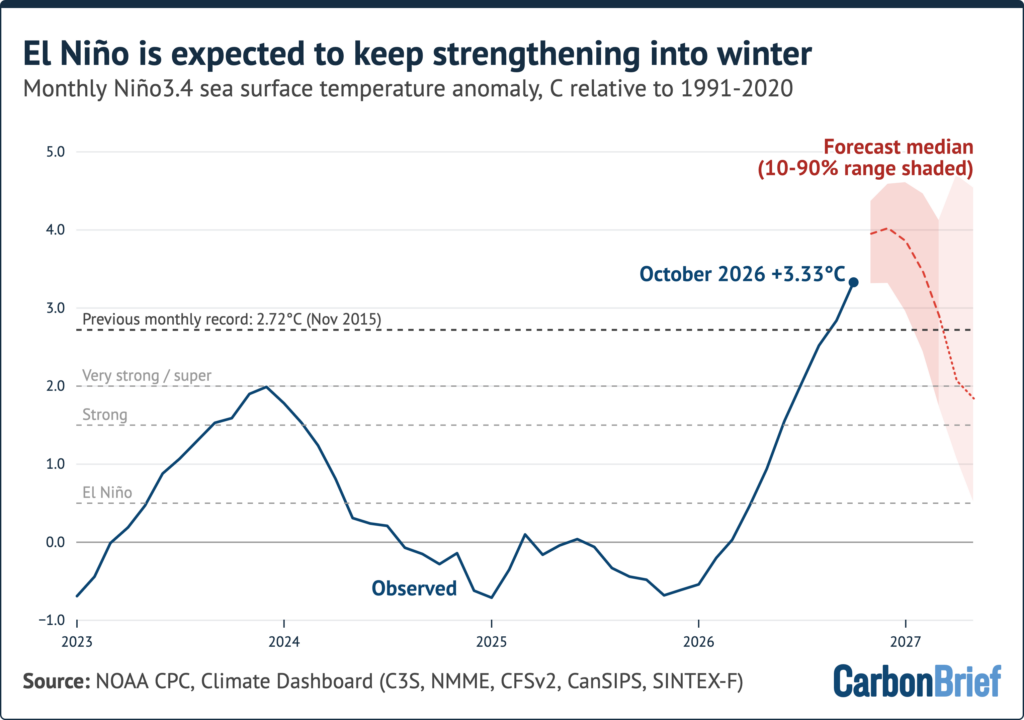
The strength of El Niño is assessed using the “Niño3.4 anomaly,” a metric that measures sea surface temperature deviations in the central Pacific. Analysis conducted by Hausfather assessed over 600 forecasts from 14 distinct climate models, revealing an anticipated anomaly of approximately 4°C at the peak of this year’s event, surpassing the previous record of over 1°C from the 2015-16 El Niño.
Historical Context and Future Projections
On November 5, Hausfather released details stating that the current El Niño is developing at an unprecedented rate, reaching sea surface temperatures not previously observed in historical records, potentially making it the strongest El Niño of the last millennium.
This year’s El Niño has already set significant benchmarks. On September 18, the daily Niño3.4 region anomaly recorded a staggering temperature of 3.11°C, breaking the previous satellite-era record. Additionally, September saw an average anomaly of 2.84°C, the highest since the inception of recorded sea surface temperatures in the mid-1800s.
Hausfather noted that this El Niño event has been consistently performing above previous iterations since June, at times exceeding by a full degree Celsius. Projections from Carbon Brief indicate that El Niño will continue to gain intensity through December, with 10 out of 14 models predicting peak temperatures for the Niño3.4 region in December, while others forecast a peak in November.
Long-term Implications for Global Temperatures
Although human-induced greenhouse gas emissions largely drive long-term global warming, variations in specific years, such as those influenced by El Niño events, significantly affect temperature readings. The analysis anticipates that the current El Niño will achieve its most substantial impact on global temperatures in 2027, given that there is typically a three-month lag between ocean warming in the tropical Pacific and global temperature changes.
Carbon Brief predicts that the average global temperature in 2027 will likely soar to approximately 1.74°C above pre-industrial levels, with a remarkable 96% chance that 2026 will be recorded as the hottest year on record. These predictions are derived from historical patterns linking year-on-year temperature fluctuations to previous El Niño conditions.

Chief Editor of Quincy City Beat — Quincy, MA's independent investigative newspaper covering Greater Boston and the entire Commonwealth of Massachusetts with fearless public accountability and free access for all readers.










Discussion about this post