

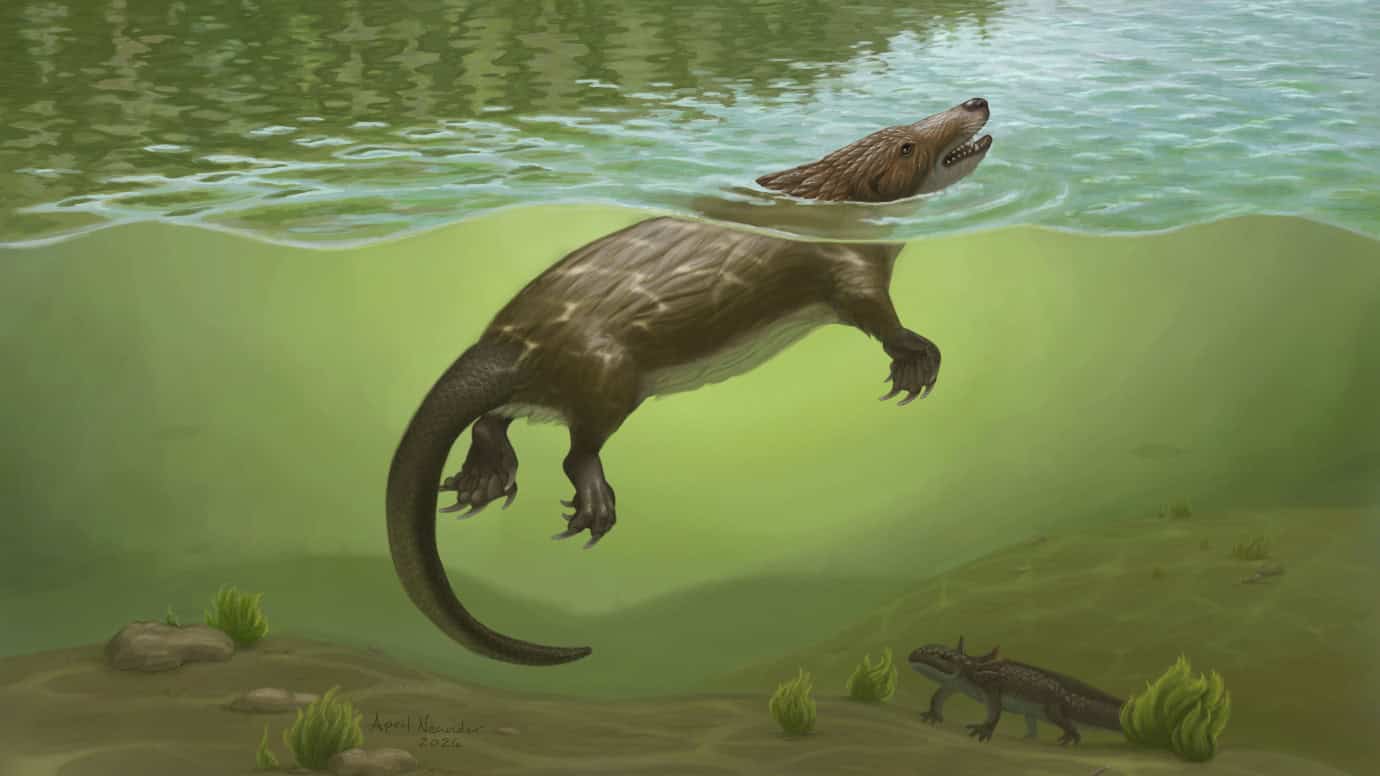
Researchers have unveiled a newly identified species from the Jurassic era, dubbed Megacauda sungei, a fascinating creature that is reshaping our understanding of semiaquatic mammals. This intriguing species, which lived approximately 165 million years ago, displayed numerous features reminiscent of modern otters, but it is not directly related to them.
Known as “big tail,” Megacauda measured about the size of a Chihuahua and exhibited a flattened tail for swimming, while its hind legs closely resembled those of a platypus. This predator roamed the waterways of present-day northern China during an age dominated by dinosaurs.
Unique Anatomy: A Combination of Features

Excavated from Inner Mongolia, the fossil dates back 163–168 million years. With a length of 40 to 50 centimeters and weighing one to two kilograms, Megacauda stood out as a rather large specimen among its contemporaries. Its anatomy—with elongated outer toes and mobile ankles—implies adaptations for efficient locomotion in water.
Researchers speculate that Megacauda may have hunted in aquatic environments while finding refuge in land-based burrows, akin to the behavior of modern platypuses.

Featuring oversized canines and shearing cheek teeth, Megacauda was built for predation. Analysis of its stomach contents revealed small vertebrate bones, indicating a diet that likely included local salamanders.
Although another swimming docodont, Castorocauda, was identified previously, Megacauda‘s more complete skeleton offers invaluable insights into the evolutionary lineage of aquatic mammals.

Advanced Feeding Mechanisms Revealed
Utilizing CT scans and X-ray fluorescence imaging techniques, researchers made a surprising discovery beneath the fossil’s skull: a collection of hyoid bones, which are integral to supporting the tongue and facilitating swallowing in living mammals.
According to Zhe-Xi Luo, senior author and paleontologist at the University of Chicago, the identification of these hyoid bones suggested a complex, coordinated swallowing mechanism similar to that of modern mammals.
By comparing these bones to those of extant mammals, scientists digitally reconstructed Megacauda’s throat, revealing its ability to execute coordinated movements necessary for effective feeding.

The findings suggest that the sophisticated feeding system may have evolved before the split between docodonts and the ancestors of modern mammals. An intriguing aspect of this discovery is the coexistence of both ancient and advanced features in Megacauda’s throat, indicating a more complex evolutionary history than previously believed.
Notably, the hyoid bones indicate a refined mechanism for swallowing, further hinting at the feeding adaptations of ancient mammals. This poses questions about the evolutionary pathways of current monotremes like platypuses and echidnas, possibly tracing back to features similar to those found in Megacauda.
Evolution of Feeding Strategies in Mammals
The ability to chew and swallow food in a controlled manner developed significantly in early mammalian ancestors, which existed hundreds of millions of years before Megacauda. Innovations such as specialized teeth and the secondary palate allowed for efficient chewing while breathing.
Transitioning to more precise swallowing techniques required the evolution of flexible hyoid bones and specialized throat muscles. Previous studies have indicated that adaptations for swallowing were present long before the emergence of modern mammals.
Over millennia, adaptations have allowed mammals to exploit diverse diets, ranging from insects to larger prey, all while maintaining efficient swallowing mechanisms. This evolutionary lineage demonstrates a remarkable adaptability that has persisted through the extensive diversification of dietary habits among mammals.
This groundbreaking study was published in the journal Nature, marking a significant advance in paleontological research.

Chief Editor of Quincy City Beat — Quincy, MA's independent investigative newspaper covering Greater Boston and the entire Commonwealth of Massachusetts with fearless public accountability and free access for all readers.









Discussion about this post